


Features of TSINFA 4 Axis Machining Center
- Within the same time frame, a four axis machining center can produce more work pieces than a three axis machining center.
- A four axis machining center eliminates the need for repeated work piece clamping, effectively avoiding errors caused by repeated positioning.
- On a four axis machining center, work pieces can rotate flexibly, providing more angles and possibilities for machining.
- TSINFA ‘s four axis machining centers have obtained CE certification from the European Quality Management Committee.
- TSINFA ‘s four axis machining centers feature a robust box type structure reinforced internally with stiffeners, ensuring high rigidity.
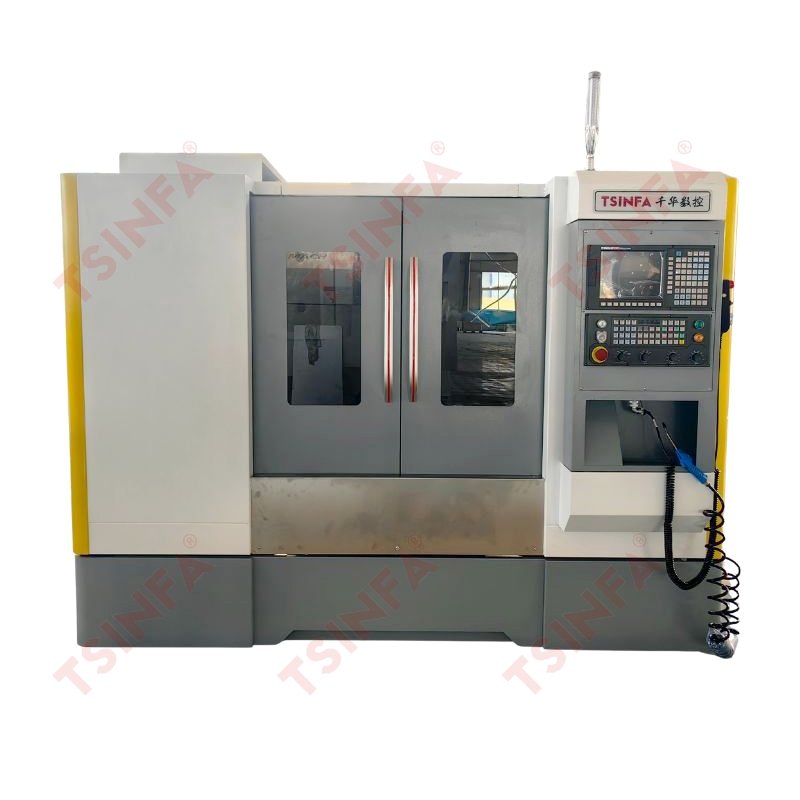


The Advantages of a 4 Axis Machining Center

The addition of a rotary axis can enhance the machining center’s operational flexibility during the milling. Compared to processing flat surfaces and simple shapes, 4 axis machining centers offer greater operational angles to produce more complex mechanical components, this gives more machining possibilities and expands the range of parts that can be manufactured.

Fully automated machining can significantly reduce the setup time and labor costs for 4 axis machining centers. This efficiently shortens the production cycles and may even generate additional revenue. Within the same time allowed, you can produce more parts.

A 4 axis machining center also delivers a higher production efficiency. The rotary axis can enhances the machine’s automation capabilities. It can automatically adjust the work piece’s orientation without requiring an operator to remove and reinstall it, this can also reduce the errors that may occur during the reposition.
The Applications of a 4 Axis Machining Center

In the aerospace sector, four axis machining centers can produce multi axis components such as engine blades, turbines, and brackets. These parts often have multiple curved surfaces and demand exceptional precision due to the aerospace requirements, so it is proper to manufacture these components by four axis machining centers.

In automotive manufacturing, 4 axis machining centers process components like engine blocks and crankshaft housings featuring multiple planes and angles. They ensure a smooth surface of these components to meet automotive production requirements.

In the medical field, implants and their device housings often feature complex structures. While four axis machining centers are precisely capable of ensuring the high precision in the machining of these components’ curved surfaces, thereby guaranteeing the installation accuracy and safety.

In the home furnishings sector, four axis machining centers can produce furniture with arcs or beveled surfaces, such as wooden chairs and tabletops. Their short processing cycles and high efficiency make them suitable for mass production.
What is a 4 Axis Machining Center?
A four axis machining center is a type of CNC milling machine.The term “four axis” refers to the addition of a motorized indexing head capable of 360 degrees rotation to the standard three axis configuration.
This rotational axis can significantly enhance the machining flexibility, allowing operations to extend beyond the conventional top, flat, and side surfaces. It enables access to additional angled surfaces, facilitating the production of more complex components with curved contours.
During actual machining, the tool moves along the X,Y,Z axes for cutting, while the newly added fourth axis (A axis) enables the tool to cut along the work piece contour and further expands the freedom of milling operations.
If you are seeking a dependable CNC machining center supplier, contact TSINFA immediately. Our CNC milling machines deliver consistent quality, providing your business with reliable assurance.
What are the Components of a 4 Axis Machining Center?
Basic Structure
The fundamental structure of a four-axis machining center includes the bed, guide ways, column, worktable, base, and other components. These elements collectively form the overall framework of the machining center, providing stable support for its operations while ensuring the overall rigidity and durability.
Take the worktable as an example; this is also the section where your machine processes parts. Work pieces of various shapes are secured here and undergo the milling process to achieve their final form, and ultimately become essential components of diverse industrial products.
Spindle Head
The spindle head typically houses components such as the drive motor, spindle, and bearings. It serves as the power source for the machining center, controlling nearly every action performed by the machine.
Tool Changer
The automatic tool changer is another defining feature of a four axis machining center. This automation significantly streamlines the machining process, boosting operational efficiency.
Auxiliary Systems
The auxiliary systems of a four axis machining center involve cooling, chip removal, hydraulics, safety, and pneumatic components. And these systems will ensure the smooth and reliable operation of your machine together.
The Types of 4 Axis Machining Centers
Horizontal 4 Axis Machining Center
The defining feature of the horizontal four axis machining center is its spindle axis parallel to the worktable. This allows the machined components to be suspended, enabling chips to fall away easily under gravity and be cleared by our chip removal system.
Compared to vertical four axis machining centers, the horizontal configuration can process larger and heavier work pieces due to its reduced overhead space constraints and their stability. Additionally, the horizontal orientation of the work piece ensures more uniform stress distribution across the table surface, minimizing the significant deformation of the worktable.
Vertical 4 Axis Machining Center
A vertical machining center refers to a milling machine where the spindle axis is perpendicular to the worktable. Our A axis indexing rotary table is also positioned vertically relative to the worktable. This design simplifies work piece clamping. Another advantage of vertical machining centers is the clear visibility of the production process, allowing operators to monitor machining conditions at any time and promptly identify issues.
The spindle of it is positioned above the worktable to ensure ample working space while saving the floor area. Moreover, on vertical four axis machining centers, the orientation of the drawing matches the placement of the work piece, making observation during operation more intuitive.
Compared to horizontal machining centers, vertical models offer greater operational flexibility and achieve higher machining precision.
However, vertical machining centers are unsuitable for excessively tall work pieces due to their limited overhead clearance. They also exhibit lower chip removal capabilities, as the machine’s structure causes the generated chips accumulating on the worktable during processing.
How to Operate a 4 Axis Machining Center?
Preparation
Before starting the machining center, you must take the preparations. This includes inspecting the equipment for proper condition, checking for rust, and ensuring sufficient coolant. If the equipment is in good working order, you can then load the material to be machined and prepare to start the machine.
Inputting Code to the Issue Commands
After the startup, the first thing you need to do is to set up the coordinate system and import the model’s CAM program into the machining center’s CNC system. These programs can be converted into G code to control the movement of the tools. In the meantime, M codes are imported into the CNC system to assist the machine’s actions, such as the spindle rotation and so on.
Actual Machining
Once preparations are complete and commands are entered, your 4 axis machining center will perform the milling that is guided by the G code. During this process, real time sensor displays allow engineers to monitor critical parameters like operating temperature and load.
Post Processing
After all the machining processes are complete, the final part may still not be perfectly finished. Its surface will require deburring, polishing, and other treatments to achieve a better appearance and ensure it to fit with the equipment better.
Then the following step is the quality inspection , you need to conduct it to guarantee the part will meet the standards.
How to Choose a Proper 4 Axis Machining Center
Understanding the Essential Parameters
Just like purchasing any equipment, before selecting a four axis machining center, you need to understand which parameters are essential to know.
Taking a four axis machining center as an example, you need to know its worktable dimensions, which determine the maximum size of work pieces it can process. Additionally, for electrical specifications, you must consider its power rating. This indicates its power consumption during operation and overall capability.
Typically, 4 axis machining centers range from 7.5 to 30 kW. If you need to process higher strength materials like cast iron or steel, a higher power rating is needed too, as it can to ensure adequate milling capacity for these materials.
Consider the CNC System Brands
You should also evaluate the CNC system brand used in your selected four axis machining center. The most common brands include GSK, FANUC, Siemens, and Mitsubishi, etc. Different brands vary in price and performance, you can choose the most suitable option based on your requirements.
Selecting a Reliable Manufacturer
The most important consideration when purchasing is working with a reliable manufacturer. You need to verify their operational credentials and expertise by directly requesting the professional certification to the manufactures. Then, it is equally necessary for you to confirm that their products have been tested by international safety authorities and with authoritative certifications such as ISO or CE to further ensure the products’ safety.
TSINFA has specialized in CNC machine tool manufacturing for fifteen years. We hold independent import/export rights and have obtained CE certification from the European Quality Management Committee along with ISO9001:2015 Quality Management System certification. Committed to integrity and quality, we welcome your immediate contact.
A 4 axis machining center is an automated device that operates by receiving programmed instructions to direct the machine’s actions. It employs motor driven mechanisms to rotate or move cutting tools and can automatically complete the specified machining tasks.
In fact, a 3 axis machining center only includes movement along the X, Y, and Z axes, enabling 3D machining of work pieces to create three dimensional structures. By combining movements along these axes, curved surfaces can be generated. From the finished product perspective, the capabilities of three axis machining are already quite substantial, it is sufficient to meet the needs of small or simple machining operations.
However, the addition of a rotational axis in a four axis machining center unlocks the capability to process more complex curved surfaces. For instance, when machining multiple faces, there is no need to repeatedly disassemble the work piece for operation. This avoids issues like positioning inaccuracies caused by repeated disassembly. Simply rotating the work piece on the machine allows the four axis center to process multiple planes.
Therefore, compared to three axis systems, four axis machining centers offer greater operational flexibility, enabling the seamless production of curved components like aircraft engine blades.
The installation of the rotary axis enables the four-axis machining center to produce complex geometric parts. These include components such as impellers or turbine parts, which require tools to smoothly cut across the surface to form flowing bevels. Additionally, it can manufacture polyhedral parts and work pieces with inclined holes, such as engine pump housings, connectors, and similar components.
Routine maintenance includes debris removal before and after operation, cleaning the machine surface, and timely replenishment of lubricants and coolants.
Generally, we recommend the maintenance schedule including cleaning and chip removal before and after use, comprehensive inspections and filter cleaning should be taken weekly, and a monthly deep maintenance such as thorough cleaning and inspection of internal and external components, along with system parameter backups. In summary, incorporating thorough cleaning and maintenance practices into routine usage habits is essential for preserving equipment longevity.
Of course, standardized operating procedures are more critical than any maintenance method, as improper usage often causes greater damage than debris or dust. Therefore, personnel training must emphasize correct machine operation to prevent overloading equipment and shortening its service life.

